
Gauntlet AI · 2026
AutoPortfolio
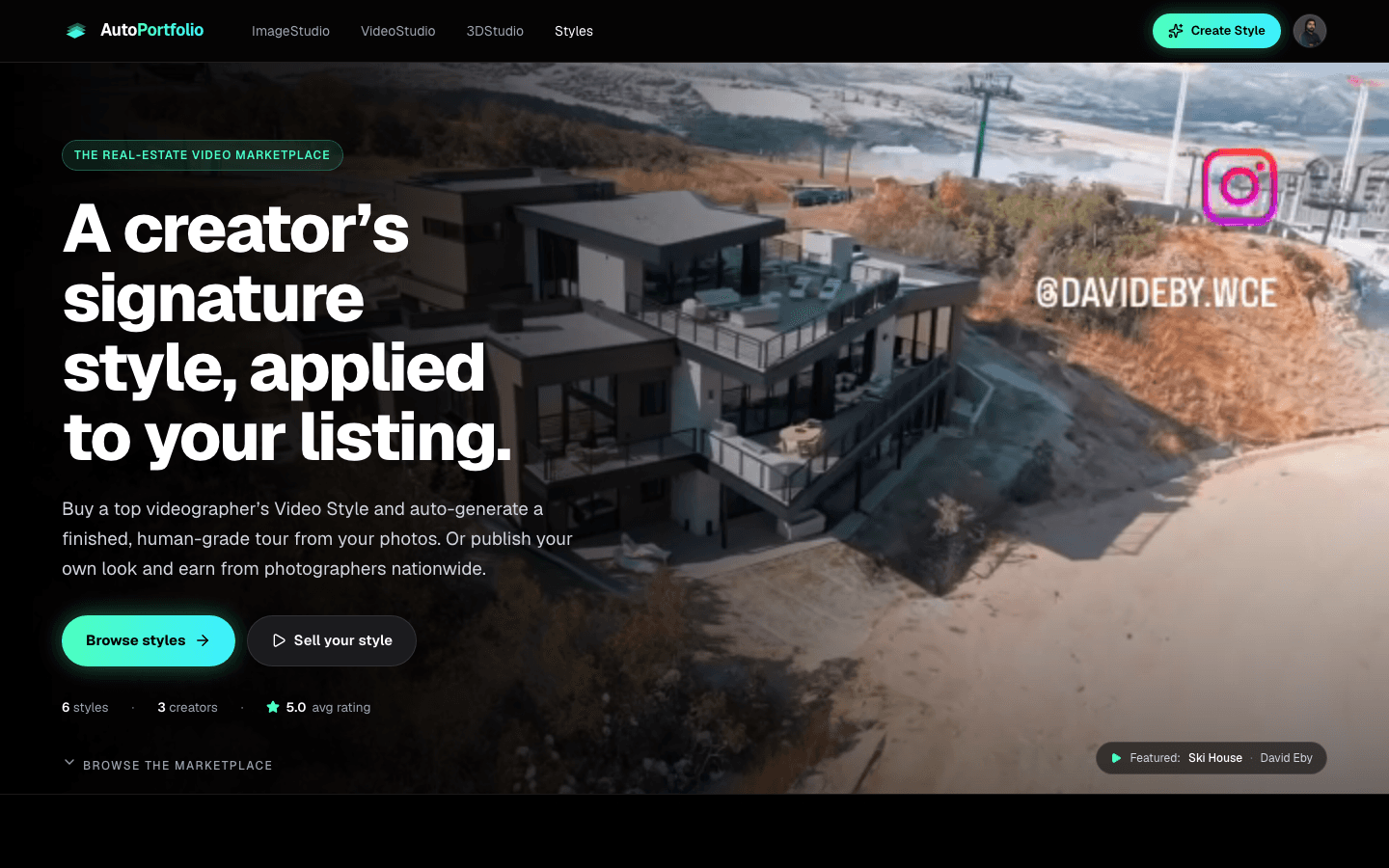
AI photo to video studio. Real-estate photos in, a cinematic video tour out
- Role
- Solo builder: product, web app, generation pipeline design
- Timeline
- Hackathon (AutoHDR)
- Stack
The problem
Listing videos sell homes, but a videographer's edit is expensive and slow. Listings already have professionally edited photos. The hackathon bet: the gap between photos and a watchable video tour is editorial intelligence, and that can be modeled.
The approach
A polyglot system joined by a language-agnostic REST/JSON seam. The Next.js web app runs the full UX (Discover → Evaluate → Upload → Generate → Review → Video Studio), deployed on Vercel. The Python pipeline does the heavy lifting off-Vercel: editorial image-to-image (Flux Kontext), camera-move image-to-video (Kling 2.5 Turbo Pro), and beat-aligned ffmpeg assembly with a color grade, all sequenced to mimic a reference videographer's cut rhythm.
The hard parts
Generation takes minutes, serverless takes seconds
Video generation cannot live inside a serverless request. The API contract splits the system so the web tier stays responsive while the pipeline runs long jobs. Five route handlers form the seam, and the pipeline swaps in behind the same shapes without UI changes.
Cloning taste, not just motion
The differentiator isn't 'photos move'; it's that shot order, pacing, and grade feel like a specific editor's work. Encoding that edit DNA as explicit pipeline parameters is what makes output feel human-graded.
Where it landed
Live deployment with the full studio UX, an explicit API contract between web and pipeline, and a generation pipeline architecture designed for the realities of long-running media jobs.
Next project
Clinical Copilot